
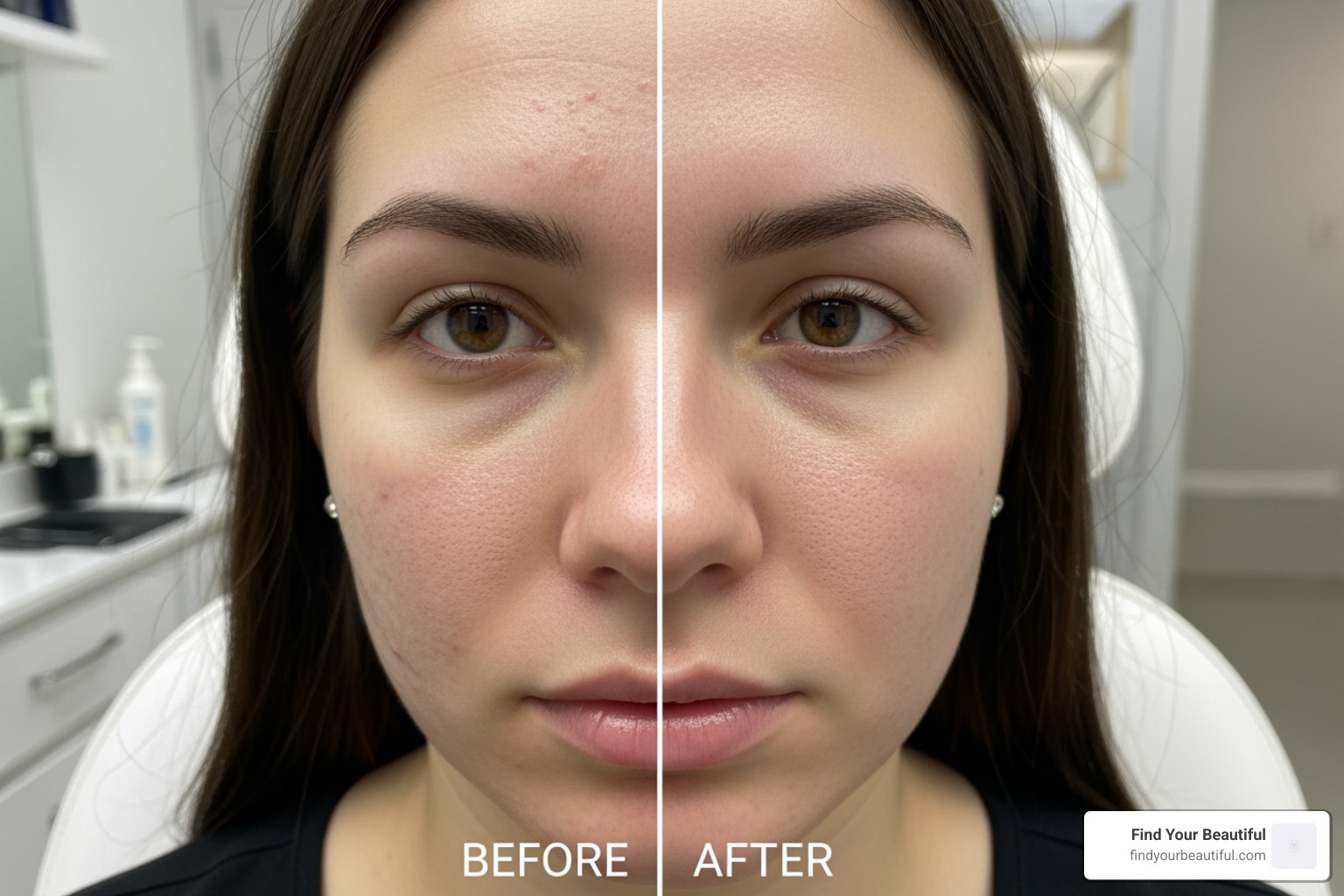
Acne Scars Are Common — But Which Treatment Actually Works?
Microneedling vs chemical peel for acne scars is one of the most searched skin treatment comparisons — and for good reason. Both can dramatically reduce acne scarring, but they work differently and suit different scar types.
Here’s a quick side-by-side to help you decide:
| Factor | Microneedling | Chemical Peel |
|---|---|---|
| Best for | Deep atrophic scars (icepick, rolling, boxcar) | Superficial scars, pigmentation |
| How it works | Stimulates collagen via micro-injuries | Exfoliates outer skin layers with acids |
| Darker skin tones | Safe for all skin types | Higher risk of hyperpigmentation |
| Downtime | 1-2 days redness | 1-10 days depending on peel depth |
| Sessions needed | 3-6 sessions | Varies by peel strength |
| Results duration | Up to 12 months | Requires more frequent maintenance |
Bottom line: Microneedling tends to outperform chemical peels for deeper acne scars. A clinical study found 73.33% of microneedling patients showed meaningful scar improvement, compared to just 33.33% with glycolic acid peels.
Acne is the 8th most common disease worldwide, affecting nearly 50 million Americans every year. Up to 85% of people aged 12 to 24 deal with it at some point. And for 12 to 14% of those people, it leaves behind permanent scarring — the kind that goes deeper than skin and affects confidence and mental well-being.
Those scars form because acne disrupts collagen production during healing. The result? Atrophic depressions in the skin — the pitted, uneven texture that no amount of concealer can fully hide.
The good news: two proven treatments can help rebuild what acne broke down.
I’m Dr. Thomas Jeneby, a board-certified plastic surgeon with over 20 years of experience performing thousands of cosmetic procedures, including the full spectrum of acne scar treatments covered in this microneedling vs chemical peel for acne scars guide. Let’s walk through everything you need to make the right call for your skin.
Microneedling vs chemical peel for acne scars word guide:
- At-Home Dermaroller vs Professional Microneedling
- Microneedling Depth for Acne Scars
- Microneedling Pain Level
Understanding Microneedling vs Chemical Peel for Acne Scars
When we look at microneedling vs chemical peel for acne scars, we are essentially looking at two different philosophies of skin renewal. One works from the inside out, while the other works from the top down.
Microneedling, often called Collagen Induction Therapy, uses a device like the SkinPen microneedling to create thousands of controlled micro-injuries in the skin. These “micro-channels” trick your body into thinking it’s injured, which kickstarts a massive healing response. Your skin begins pumping out fresh collagen and elastin to repair those tiny holes. Because the needles can reach into the dermis (the deeper layer of skin), microneedling is highly effective at “filling in” the depressions left by atrophic scars.
Chemical peels, on the other hand, focus on chemical exfoliation. We apply a specialized acid solution to the skin that dissolves the “glue” holding dead skin cells together. This causes the top layers of the epidermis to peel away, revealing smoother, more evenly pigmented skin underneath. While peels are fantastic for surface texture and post-inflammatory hyperpigmentation (those red or brown marks left after a zit heals), they often struggle to reach the structural depths required to fix deep pitting.
According to scientific research on microneedling efficacy, microneedling is increasingly favored for its ability to remodel the skin without removing the entire top layer, leading to faster healing and fewer complications.
How Microneedling Targets Deep Scars
Atrophic scars—those little “craters” in the skin—are essentially areas where the skin’s foundation has collapsed. To fix them, we need to rebuild that foundation.
When the SkinPen needles penetrate the scar tissue, they break up the old, stiff bundles of collagen that are pulling the skin downward. This mechanical disruption, combined with the release of growth factors, stimulates the production of new, organized elastin and collagen fibers. Over a series of treatments, the floor of the scar gradually rises until it is level with the surrounding skin.
For those looking for even more intensive results, we often suggest RF microneedling, which adds radiofrequency energy to the needles. This heat energy tightens the skin further and accelerates the remodeling process, making it a powerhouse for stubborn boxcar or rolling scars.
How Chemical Peels Resurface the Skin
Chemical peels are like “exfoliation on steroids.” They come in different strengths, which we tailor to your specific needs:
- Superficial Peels: Usually involve Alpha-Hydroxy Acids (AHAs) like glycolic acid or Beta-Hydroxy Acids (BHAs) like salicylic acid. These are great for unclogging pores and brightening the skin.
- Medium Peels: Often use Trichloroacetic Acid (TCA) to reach the upper part of the dermis. These are more effective for mild acne scarring and fine lines.
- Deep Peels: Use phenol to reach deep into the dermis. While powerful, these involve significant downtime and are rarely used today because modern lasers and microneedling offer similar results with much less risk.
If you want your skin to feel amazing, a peel is an excellent way to refresh your complexion, but if your main concern is deep “pitting,” the peel might only be half the battle.
Comparing Efficacy: Which Treatment Wins for Your Scar Type?
Not all acne scars are created equal, and neither are the treatments. To choose between microneedling vs chemical peel for acne scars, you first need to identify which “flavor” of scarring you have.
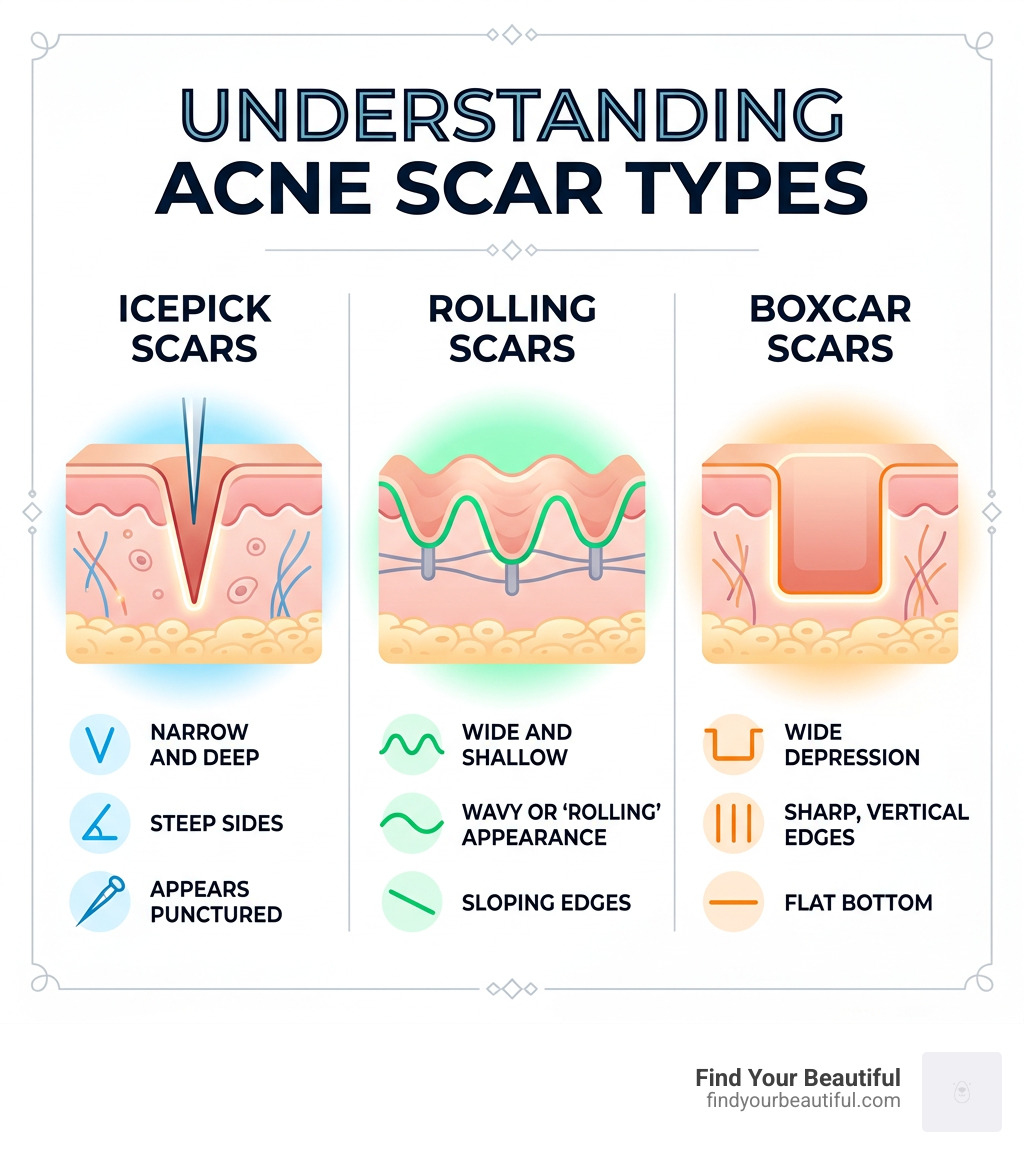
- Icepick Scars: These are narrow, deep holes that look like the skin was punctured by an icepick. They are notoriously hard to treat because they go so deep.
- Rolling Scars: These create a wave-like, undulating texture on the skin. They happen when bands of scar tissue form under the skin and pull the surface down.
- Boxcar Scars: These are round or oval depressions with sharp, vertical edges, similar to chickenpox scars.
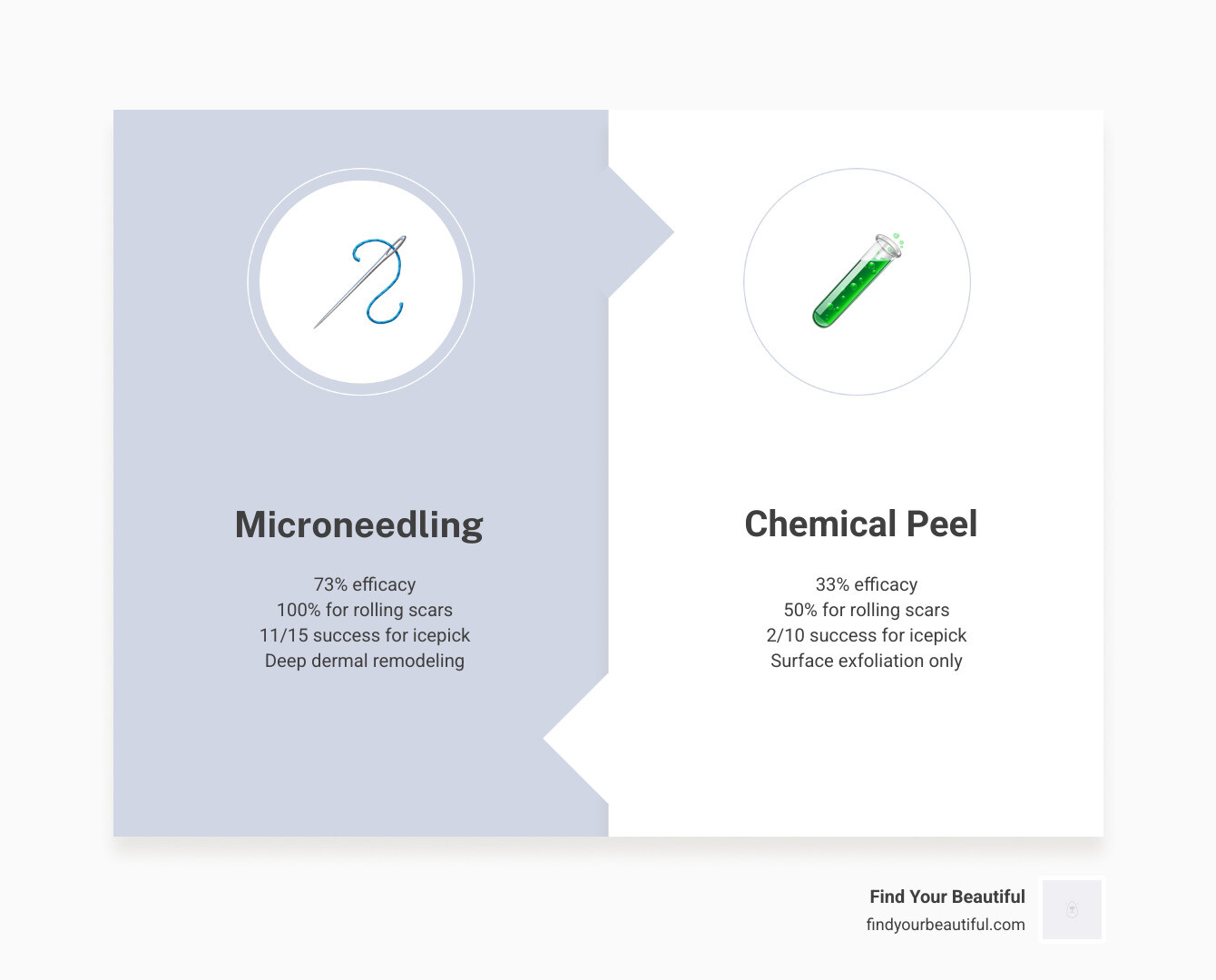
A clinical study on scar improvement showed that microneedling was significantly more effective across the board. For icepick scars, 11 out of 15 patients saw success with microneedling, compared to only 2 out of 10 with peels. For rolling scars, microneedling had a 100% efficacy rate in the study group, while peels only helped about half the patients.
Microneedling vs Chemical Peel for Acne Scars: The Results
If we look at the raw numbers, the winner is clear for structural change. In a head-to-head trial, 73.33% of patients treated with microneedling achieved a significant improvement (moving up at least one grade on the Goodman and Baron Scarring Grading System). In contrast, only 33.33% of those using 35% glycolic acid peels saw the same level of success.
So, what is microneedling really doing that a peel isn’t? It’s reaching the “root” of the scar. While a peel sands down the edges of a boxcar scar to make it look less prominent, microneedling builds the skin back up from the bottom.
Furthermore, microneedling results are known for their longevity. Research indicates that the skin continues to produce new collagen for months after the last session, with improvements maintained for up to 12 months. Chemical peels often require more frequent “maintenance” sessions to keep the skin looking smooth.
Safety for Darker Skin Tones and Fitzpatrick Types
This is where the conversation gets very important. In San Antonio, we have a beautifully diverse population with many different skin tones. If you have a darker complexion (Fitzpatrick types IV-VI), you have to be extremely careful with chemical peels.
Many chemical peels work by creating a controlled “burn.” In darker skin, this inflammation can trigger the melanocytes (pigment-producing cells) to go into overdrive, leading to post-inflammatory hyperpigmentation (PIH). Essentially, you might trade an acne scar for a dark brown smudge that lasts for months.
Microneedling is generally much safer for skin of color. Because it doesn’t involve heat (unless it’s RF) or harsh acids that strip the epidermis, the protective barrier of the skin remains mostly intact. This significantly reduces the risk of dyspigmentation. Research on microneedling in skin of color confirms it is a first-line treatment for scarring in patients with darker skin tones because it provides excellent results with a very low risk of pigment changes.
Treatment Process, Downtime, and Recovery Expectations
What does it actually feel like to get these treatments? We want you to be prepared!
The Microneedling Experience: Before we begin, we apply a medical-grade topical numbing cream. Most of our San Antonio patients describe the sensation as a light “prickling” or like a vibrating toothbrush being moved across the face. It’s not painless, but it’s very tolerable.
- Immediately after: You’ll look like you have a moderate sunburn.
- Day 1-2: The redness fades to a pinkish hue. You might feel a bit tight or dry.
- Day 3-5: Some light flaking might occur as the old skin makes way for the new.
- Aftercare: You must be a “vampire” for a few days—stay out of the sun and wear a high-quality SPF 30+.
The Chemical Peel Experience: Depending on the strength, you might feel a tingling or a sharp stinging sensation when the acid is applied. We often use a small fan to keep you cool and comfortable.
- Immediately after: Your skin may look red or frosted (white).
- Day 3-7: This is the “peeling” phase. Depending on the depth, your skin might flake lightly or peel in sheets (don’t pick it!).
- Aftercare: Check out our guide on what to expect from chemical peels for a full breakdown, but the golden rule is hydration and sun protection.
Sessions Required for Optimal Results
Neither of these is a “one and done” miracle. Skin remodeling takes time.
For most patients in San Antonio looking to tackle acne scars, we recommend a series of 3 to 6 microneedling sessions, spaced about 4 to 6 weeks apart. This timing is crucial because it allows your skin’s natural 28-day cell turnover cycle to complete and for new collagen to mature.
If you choose RF microneedling services, you might see results slightly faster, but a series is still standard for the most dramatic, “wow-factor” outcomes. Chemical peels for scarring also usually require a series, though light “glow” peels can be done every month as part of a regular maintenance routine.
Can You Combine Microneedling and Chemical Peels?
Absolutely! In fact, this is often our “secret sauce” for the best results. We call it combination therapy, and it allows us to address both surface-level issues and deep structural damage simultaneously.
Think of it this way:
- The Chemical Peel cleans up the surface, removes dead skin, and fades pigment spots.
- The Microneedling goes deep to fill in the actual pits and craters.
We don’t usually do them on the exact same day (that would be a bit much for your skin to handle!), but we often alternate them. For example, you might get a microneedling session, wait four weeks, get a medium-depth peel, and wait another four weeks for your next microneedling. This “1-2 punch” addresses the structural vs surface repair needs of your skin for a truly transformed complexion.
Frequently Asked Questions about Microneedling vs Chemical Peel for Acne Scars
Does microneedling hurt more than a chemical peel?
This is subjective, but most people find microneedling with numbing cream more comfortable than a medium-depth chemical peel. Microneedling is a mechanical “prickling,” while a peel is a chemical “heat” or sting. With our high-quality numbing protocols at our Stone Oak Parkway location, our patients usually find both very manageable.
How long do the results last for each treatment?
Microneedling results can be permanent for acne scars because you are physically rebuilding the skin’s structure. However, your skin will continue to age naturally. We usually recommend an annual touch-up session to keep collagen levels high. Chemical peel results for texture and glow are temporary and require regular maintenance to sustain.
Which treatment is more cost-effective in the long run?
Chemical peels usually have a lower price point per session. However, because microneedling is significantly more effective for deep scars (remember that 73% vs 33% stat?), you may end up needing fewer total sessions of microneedling to reach your goal. When you factor in the “permanent” nature of scar remodeling, microneedling is often the better long-term investment for pitted skin.
Conclusion
Choosing between microneedling vs chemical peel for acne scars doesn’t have to be a guessing game. If you’re dealing with deep, pitted atrophic scars or have a darker skin tone, microneedling—especially with the SkinPen—is likely your “champion.” If your concerns are more about surface stains, redness, and minor texture issues, a series of chemical peels might be the perfect fit.
At Find Your Beautiful, we don’t believe in one-size-fits-all skincare. Our team of expert, board-certified surgeons and aesthetic specialists in San Antonio is here to look at your skin, your scars, and your goals to create a personalized plan that actually works.
Ready to stop hiding behind filters and start loving your skin again? Explore our med spa services or visit us on Stone Oak Parkway for a personalized skin assessment. Let’s find your beautiful, together.