

What is Microneedling and Why Choose Between Methods?
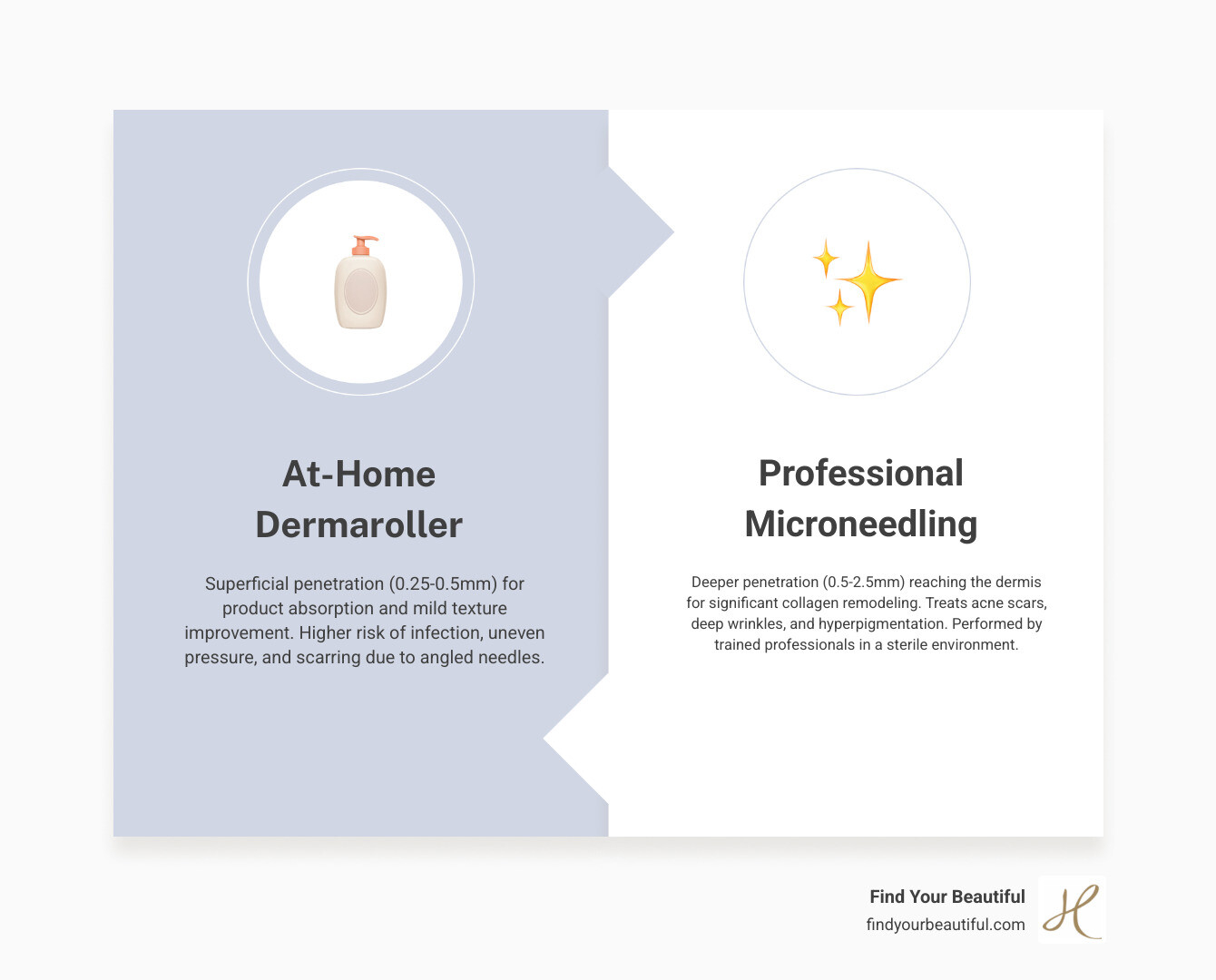
When comparing at-home dermaroller vs professional microneedling, the key differences come down to depth, safety, and results:
| Factor | At-Home Dermaroller | Professional Microneedling |
|---|---|---|
| Needle Depth | 0.25mm – 0.5mm (superficial) | 0.5mm – 2.5mm (reaches dermis) |
| Best For | Product absorption, mild texture | Acne scars, deep wrinkles, hyperpigmentation |
| Safety | Higher risk of infection/damage | Sterile environment, trained professional |
| Cost | $15-$140 one-time | $100-$700 per session |
| Results | Temporary surface improvements | Long-lasting collagen remodeling |
Microneedling, also known as collagen induction therapy, works by creating controlled micro-injuries in your skin. This triggers your body’s natural healing response, boosting collagen and elastin production for smoother, firmer skin.
The treatment comes in two main forms: at-home dermarollers that you can use yourself, and professional microneedling performed by trained aestheticians or dermatologists. While both methods use tiny needles to stimulate your skin, they differ dramatically in their approach, safety, and effectiveness.
At-home dermarollers use a rolling motion with fixed needles that enter your skin at an angle. They only penetrate the surface layer (epidermis) and are primarily useful for enhancing skincare product absorption – studies show they can increase absorption by up to 200%.
Professional microneedling uses automated pens with disposable needle cartridges that penetrate vertically into deeper skin layers. These devices can reach the dermis where real collagen remodeling happens, making them effective for treating significant concerns like acne scars and deep wrinkles.
The FDA has not approved many at-home dermarollers for home use, and many are on their import alert red list due to safety concerns about creating a sterile environment at home.
The Tools of the Trade: Dermaroller vs. Professional Microneedling Pen
Understanding the difference between at-home and professional microneedling tools is like comparing a basic kitchen knife to a surgeon’s scalpel – they might look similar at first glance, but their precision and capabilities are worlds apart. When exploring at-home dermaroller vs professional microneedling, the device differences go far beyond just size and cost.

At-Home Dermarollers Explained
Picture a tiny paint roller covered in needles instead of bristles – that’s your basic at-home dermaroller. This manual device features a simple rolling drum with fixed needles that you glide across your skin like you’re painting a delicate canvas.
Here’s where things get tricky: because you’re rolling the device, those needles don’t go straight in and out. Instead, they enter your skin at an angled entry point, creating what experts call a “scooping” motion. Think of it like dragging a rake through sand – it’s not the cleanest cut.
This angled approach has a potential for tearing your skin tissue as the needles pull out sideways rather than lifting straight up. It’s not exactly the gentle treatment your skin deserves.
Most at-home rollers offer only superficial penetration between 0.25mm and 0.5mm. That barely scratches the surface – literally. While this shallow depth is great for improved product absorption (studies show up to 200% better absorption of your favorite serums), it won’t create the deep changes you’re probably hoping for.
Professional Microneedling Devices
Now we’re talking serious business. Professional microneedling uses an automated pen that looks more like a high-tech tattoo gun than a simple roller. These devices come with disposable needle cartridges – fresh, sterile needles for every single treatment.
The game-changer here is the vertical stamping motion. Instead of rolling and dragging, professional devices punch straight down and pull straight back up. It’s like the difference between carefully using a hole punch versus tearing paper by hand.
These sophisticated tools feature adjustable needle depth ranging from 0.5mm all the way to 2.5mm. That means our skilled aestheticians can customize your treatment based on exactly what your skin needs. Fine lines? We’ll go lighter. Deep acne scars? We can reach much deeper.
The high-speed oscillation is pretty impressive too – these pens vibrate at lightning speed, creating precise micro-injuries faster than you can blink. This reaching the dermis capability is where the magic happens for significant collagen remodeling.
The needle technology in professional devices creates clean, controlled channels that heal beautifully, while the precision allows us to target specific areas and concerns with surgical accuracy.
Want to dive deeper into the science behind these treatments? Check out our guide on What is Microneedling? A Guide to New Skin Treatments.
The Critical Comparison: At-Home Dermaroller vs Professional Microneedling
Now that we’ve explored the tools, let’s dive into what really matters: how do these two approaches actually compare when it comes to your skin? The differences between at-home dermaroller vs professional microneedling extend far beyond just the device you’re using. We’re talking about completely different experiences, safety levels, and most importantly, results.

Efficacy and Results: Superficial vs. Substantial
Here’s where things get really interesting – and where the biggest differences show up. If you’re hoping for real, lasting changes to your skin, professional microneedling wins hands down. It’s not even close.
Think of it this way: at-home dermarollers are like giving your skin a gentle wake-up call. They work on the surface level, reaching only 0.25mm to 0.5mm deep into your epidermis. While this can boost product absorption by up to 200% (which is pretty cool!), it’s just not deep enough to create the kind of change most people are looking for.
Professional microneedling, on the other hand, is like having a serious conversation with your skin’s deeper layers. With needle depths ranging from 0.5mm to 2.5mm, we can reach the dermis – that’s where the magic happens. This is where your body produces collagen and elastin, the building blocks of smooth, firm skin.
What does this mean for real-world results? Professional treatments can dramatically improve deep acne scars, pronounced wrinkles, and stubborn hyperpigmentation. A scientific review of microneedling efficacy confirms what we see in our practice every day – when you can reach the dermis, you can create significant collagen remodeling.
At-home rollers might make your skin feel a bit smoother temporarily or help your serums absorb better, but they simply can’t address underlying skin concerns in a meaningful way. It’s like trying to renovate your house by just repainting the front door – it looks nice, but it doesn’t fix the foundation.
Safety, Sterility, and Precision
Let’s talk about something that keeps us up at night – safety. When you’re creating tiny wounds in your skin (which is exactly what microneedling does), sterility isn’t optional. It’s absolutely critical.
In our professional setting, we use sterile, single-use needles for every single treatment. Our licensed aestheticians work in a controlled, sterile environment and have extensive training in proper technique. We can adjust needle depth for different areas of your face – going shallower around delicate areas like your eyes and deeper where you need more intensive treatment.
The FDA has some serious concerns about at-home dermarollers. Many aren’t approved for home use, and some are actually on the FDA’s import alert red list. Why? Because maintaining a sterile environment at home is incredibly difficult, and improper sterilization can turn your dermaroller into a bacteria breeding ground.
We’ve unfortunately seen patients come to us with infections, scarring, and breakouts caused by at-home devices. One patient told us, “I thought I was saving money, but I ended up spending more fixing the damage than I would have on professional treatments.” It’s heartbreaking because it’s completely preventable.
The precision factor is huge too. Professional devices create clean, vertical punctures that heal beautifully. At-home rollers create angled tears as you roll them across your skin, which can cause unnecessary trauma and uneven results. You can learn more about our safe, professional approach with SkinPen Microneedling.
Cost vs. Value: A Financial Breakdown
Okay, let’s address the elephant in the room – cost. At-home rollers range from $15 to $140, while professional sessions run $100 to $700 each. With most people needing 3-6 sessions, you’re looking at a significant investment.
But here’s the thing about cheap solutions: sometimes the most expensive thing you can buy is something that doesn’t work. Or worse, something that causes damage you’ll need to fix later.
That $30 dermaroller might seem like a bargain until you realize it’s not giving you the results you want. Or until you develop an infection that requires medical treatment. We’ve had patients spend thousands correcting damage from DIY treatments – money they could have invested in professional care from the start.
Professional microneedling is an investment in your skin’s long-term health and appearance. You’re paying for medical-grade equipment, expert technique, sterile conditions, and transformative results that can last for months. When you break it down per month of improved skin, the value becomes much clearer.
Think of it like this: you wouldn’t perform surgery on yourself to save money, right? While microneedling isn’t surgery, the same principle applies – some things are worth having a professional handle.
Tailoring Your Treatment: Which Method is Right for You?
Deciding between at-home dermaroller vs professional microneedling is deeply personal – like choosing the right skincare routine or finding your signature style. Your unique skin concerns, goals, comfort with risk, and budget all play a role in making the best choice for you.

The good news? There’s no wrong answer here – just different paths to healthier skin. Let’s explore when each option makes the most sense for your journey.
When to Consider an At-Home Dermaroller
If you’re dealing with mild concerns and looking for gentle improvements rather than dramatic change, an at-home dermaroller might fit your needs. These devices work wonderfully for enhancing serum absorption – remember that impressive 200% increase we mentioned? Your expensive vitamin C serum will definitely thank you.
You might also find dermarollers helpful for improving surface texture. Think of it as a gentle exfoliation that leaves your skin feeling smoother and looking more radiant. It’s like giving your skin a little wake-up call without the intensity of professional treatment.
Sometimes, dermarollers serve as maintenance between professional treatments – but here’s the important part: only use one this way if your provider specifically approves it. Think of it like the relationship between professional dental cleanings and daily brushing. Your dentist might recommend certain at-home care, but they need to guide that decision.
One crucial warning: never use a dermaroller on active acne or rosacea. This can spread bacteria and make inflammation worse – definitely not the glow you’re going for!
When to Opt for Professional Microneedling
For those ready to tackle significant concerns head-on, professional microneedling is your best bet. We’re talking about addressing deep acne scars that have bothered you for years, pronounced wrinkles that makeup can’t quite hide, or stubborn hyperpigmentation that seems immune to every cream you’ve tried.
Professional treatment is also ideal if you’re dealing with stretch marks or want truly transformative results. The deeper penetration and controlled environment mean you’re investing in changes you can actually see and feel, not just hope for.
The safety and predictability of professional treatment can’t be overstated. You’re not guessing about needle depth or worrying about sterility – our trained professionals handle all of that while you relax. Plus, we can combine your microneedling with advanced techniques like growth factor serums for even better results.
Our patients often find that professional microneedling opens doors to other exciting treatments too. Many love the results they see with advanced options like SecretRF Microneedling, which combines microneedling with radiofrequency for even more dramatic skin tightening.
The bottom line? If you want safe, predictable, and transformative results for serious skin concerns, professional microneedling delivers what at-home options simply can’t match.
The Aftermath: Post-Treatment Care and Recovery
Your microneedling journey doesn’t end when the needles stop buzzing. What happens next is just as important as the treatment itself. The aftercare phase can make or break your results, and there’s a significant difference in what you’ll experience between at-home dermaroller vs professional microneedling.
Think of it this way: if microneedling is like planting seeds in your skin, aftercare is the watering and nurturing that helps those seeds bloom into beautiful results. Skip this step, and you might as well have skipped the treatment entirely.
The downtime and healing process vary dramatically between the two methods, primarily because of how deep those needles penetrate and how much your skin has been stimulated.
Aftercare for At-Home Dermarolling
Since at-home dermarollers only scratch the surface (literally), your recovery is pretty straightforward. You’ll likely see some mild redness that looks similar to a light sunburn. The good news? This typically fades within a few hours, and you can usually go about your day without anyone being the wiser.
Your post-rolling routine should focus on gentle, hydrating products. This is actually the perfect time to apply those expensive serums you’ve been hoarding – your skin is primed to soak them up like a sponge. However, here’s where many people make a mistake: they think “more is better” and pile on active ingredients.
Avoid retinol, vitamin C, and harsh acids for at least 48 hours after rolling. Your skin has tiny micro-channels that are still healing, and these actives can cause unnecessary irritation. It’s like putting lemon juice on a paper cut – technically possible, but why would you want to?
The most crucial step? Sunscreen is essential. Your freshly needled skin is more vulnerable to UV damage, which could lead to hyperpigmentation or undo any benefits you’ve gained. Think of your skin as having its defenses temporarily down – you need to be its bodyguard.
Aftercare for Professional Microneedling
Professional treatments go deeper, so your skin needs more time and care to recover. Expect 24-48 hours of redness and swelling that might make you look like you spent too long at the beach. Some patients describe it as feeling tight or warm, similar to a moderate sunburn.
Don’t panic – this is completely normal and actually a good sign that your skin is getting to work building new collagen.
Our team at Find Your Beautiful provides detailed, personalized aftercare instructions because following provider instructions is crucial for optimal results. We typically recommend medical-grade healing serums that are specifically formulated to support your skin’s natural regeneration process. These aren’t your typical drugstore products – they’re designed to work with your skin while it’s in this heightened healing state.
Strict sun avoidance isn’t negotiable during your recovery period. We’re talking about wearing a high-SPF sunscreen religiously and avoiding direct sun exposure for at least a week. You’ll also need to skip makeup, intense workouts, and saunas for a few days. Think of it as giving your skin some well-deserved downtime.
Following these guidelines isn’t just about avoiding complications – it’s about maximizing your treatment investment. Professional microneedling isn’t cheap, and proper aftercare ensures you get every penny’s worth of collagen-boosting benefits. It’s the difference between planting a garden and then forgetting to water it versus nurturing it into something spectacular.
The healing process might require a bit more patience, but the results speak for themselves. Our comprehensive approach to aftercare is part of what makes professional treatments so effective, as detailed in our guide on Achieving Radiant Skin with Professional Medspa Treatments.
Frequently Asked Questions about At-Home Dermaroller vs Professional Microneedling
We hear these questions every day in our San Antonio practice, and honestly, we love answering them! Understanding the difference between at-home dermaroller vs professional microneedling can feel overwhelming, so let’s break down the most common concerns our patients share with us.
Is at-home microneedling actually worth it?
Here’s the honest truth: it depends entirely on what you’re hoping to achieve. If you’re looking to boost your skincare product absorption and see some minor texture improvements, an at-home dermaroller can offer modest benefits. Think of it as giving your expensive serums a little extra push to work harder.
But here’s where we need to set realistic expectations. If you’re dealing with significant concerns like deep acne scars, pronounced wrinkles, or stubborn hyperpigmentation, then frankly, at-home microneedling isn’t going to cut it. The shallow penetration just can’t reach deep enough to trigger the meaningful collagen remodeling you need for real change.
We often tell our patients to think of dermarollers as a nice prep tool – like exfoliating before applying makeup. It’s helpful, but it’s not going to give you the dramatic results that bring people to our clinic.
Can I use a dermaroller between my professional microneedling sessions?
We get this question a lot, and we totally understand the thinking behind it. You’ve invested in professional treatment, and you want to maximize those results at home, right?
It is generally not recommended, and here’s why. Using a dermaroller between professional sessions can actually work against you. You might end up over-treating your skin, leading to irritation and damage. Even worse, you could disrupt the carefully orchestrated healing cycle that your professional treatment started.
Think of it this way – your skin is doing some serious construction work after a professional session, rebuilding collagen and repairing itself. Adding more trauma during this delicate process is like interrupting a chef mid-recipe. It rarely ends well.
Always consult your provider first if you’re considering any at-home maintenance. We can guide you on whether it makes sense for your specific skin and treatment plan, or suggest better alternatives that won’t interfere with your progress.
How many professional microneedling sessions will I need?
This is probably our most frequently asked question, and the answer is beautifully individual. Most patients require a series of 3 to 6 treatments, spaced about 4 to 6 weeks apart, to achieve optimal results.
But here’s what really determines your treatment plan: your specific skin concerns and goals. Someone dealing with mild texture issues might see great results in 3 sessions, while deeper acne scars might need the full 6 treatments to achieve that smooth, even complexion you’re after.
The spacing between treatments isn’t arbitrary either. Your skin needs that 4-6 week window to heal properly and ramp up collagen production. It’s like giving your skin time to show off the work it’s been doing behind the scenes.
During your consultation with our expert team, we’ll create a personalized treatment plan that’s custom specifically to your skin’s needs and your aesthetic goals. No cookie-cutter approaches here – just results designed uniquely for you.
The Verdict: Achieving Your Best Skin Safely
After diving deep into the at-home dermaroller vs professional microneedling comparison, the choice becomes crystal clear. Think of it like comparing a bicycle to a sports car – both will get you moving, but one will take you much further, much faster, and much more safely.
At-home dermarollers do have their place. They’re like that reliable friend who’s always there for you – helpful for boosting product absorption and giving you a gentle surface texture improvement. If you’re looking for a mild glow or want your expensive serums to work a little harder, they can deliver on those modest promises.
But here’s where the story takes a turn. When it comes to efficacy, safety, and precision, professional microneedling is in a league of its own. It’s the difference between painting a fence and creating a masterpiece. Professional treatments can reach those deeper dermal layers where real magic happens – where collagen and elastin production transforms your skin from the inside out.
The safety factor alone makes professional treatment worth considering. We’ve seen too many cases where well-intentioned DIY attempts led to infections, scarring, or skin damage that required professional intervention to fix. It’s like trying to perform surgery in your bathroom – the risks simply outweigh any potential savings.
Yes, professional microneedling requires a bigger investment upfront. But think about it this way: you’re not just paying for a treatment, you’re investing in transformative, long-lasting results for healthier, more radiant skin. You’re also paying for peace of mind, knowing that trained professionals are using sterile, medical-grade equipment in a controlled environment.
The truth is, while at-home rollers offer a superficial boost, professional microneedling provides the transformative, long-lasting results that can truly address concerns like acne scars, deep wrinkles, and stubborn hyperpigmentation. It’s the difference between touching up a painting and creating an entirely new canvas.
The best first step toward achieving your skin goals is always a professional consultation. Our experienced team at Find Your Beautiful understands that every person’s skin is unique, and we’re here to create a personalized treatment plan that’s custom specifically to your needs, concerns, and goals.
Ready to find what professional care can do for your skin? Explore our Medspa Services and let us help you find your beautiful – safely, effectively, and with results that will make you smile every time you look in the mirror.