Why a Tummy Tuck Could Transform Your Confidence
A tummy tuck, or abdominoplasty, is a surgical procedure that removes excess skin and fat from the abdomen and tightens underlying muscles for a flatter, firmer profile. As one of the most popular body contouring procedures, over 160,000 were performed in the United States in 2022 alone.
Quick Tummy Tuck Facts:
- What it does: Removes excess skin, eliminates stubborn fat, repairs separated abdominal muscles
- Best for: People with loose skin after pregnancy or major weight loss
- Recovery time: 4-6 weeks to return to normal activities, up to 3 months for final results
- Procedure length: 1-5 hours depending on complexity
- Results: Permanent with stable weight maintenance
Many people struggle with abdominal changes that diet and exercise can’t fix, such as loose skin after pregnancy, separated abdominal muscles (diastasis recti), or stubborn fat pockets. These issues can significantly impact body confidence.
Beyond aesthetics, tummy tucks offer functional benefits. Research shows that repairing separated abdominal muscles can improve back pain and posture.
While not a weight loss solution, a tummy tuck can be life-changing for the right candidate. Understanding what the procedure entails and whether you are a good fit is the first step.

What is a Tummy Tuck and Why Do People Choose It?
Life changes our bodies, and the midsection often bears the brunt of these changes. For concerns that seem impossible to fix on your own, a tummy tuck offers a comprehensive solution.
What is a Tummy Tuck (Abdominoplasty)?
A tummy tuck, medically known as abdominoplasty, is a sophisticated procedure that reshapes the midsection by addressing multiple concerns at once. During the procedure, our surgeons remove excess skin and fat that has lost its elasticity. More importantly, we tighten the underlying abdominal muscles (rectus abdominis), which often become stretched and separated (a condition called diastasis recti) due to pregnancy or significant weight changes.
This muscle repair, known as fascia repair, involves stitching the separated muscles back together. This not only creates a smoother profile and firmer abdomen but can also provide functional benefits like improved posture and reduced back pain. The result is a flatter, more toned-looking midsection that reflects your healthy lifestyle. For a deeper dive, check out our detailed guide: More info about the reasons to get a tummy tuck.
Common Reasons for Abdominal Changes
Many factors beyond our control can affect how our midsection looks and feels.
Pregnancy is the most common reason women consider a tummy tuck. The skin stretches dramatically, and abdominal muscles separate to accommodate a growing baby, often not bouncing back completely.
Significant weight fluctuations from weight loss can leave behind loose, sagging skin that has been stretched beyond its ability to contract.
The aging process naturally reduces collagen and elastin, the proteins that keep skin firm. Over time, this leads to a loss of skin elasticity.
Heredity can play a role in where your body stores fat and the strength of your connective tissue, predisposing some to a protruding abdomen.
Prior surgery, such as C-sections, can alter the midsection’s contour due to scar tissue and adhesions.
Weakened connective tissue and poor skin elasticity often go hand-in-hand. When the fascia holding abdominal muscles weakens, the muscles can separate, creating a “pooch” that crunches can’t fix.
These changes can be frustrating when you’re doing everything “right.” A tummy tuck addresses these underlying structural issues that lifestyle changes alone cannot.
Exploring Candidacy and Types of Abdominoplasty
While a tummy tuck can create amazing changes, it’s not right for everyone. Let’s explore who makes the best candidate and which type of procedure might work best for you.
Who is an Ideal Candidate?
A tummy tuck is a body contouring procedure, not a weight-loss solution. The best candidates share several key traits:
- Stable weight: You should be at or near your ideal weight (ideally a BMI under 32) and have maintained it for at least 12 months.
- Good general health: You should be in good health without uncontrolled chronic conditions that could complicate surgery.
- Non-smoker: You must be a non-smoker or be able to quit before and after surgery, as smoking severely impairs healing.
- Realistic expectations: You understand that the procedure creates a flatter abdomen but leaves a permanent scar.
- Finished having children: Future pregnancies can re-stretch the skin and muscles, compromising the results.
- Bothered by loose skin: You are concerned about loose, sagging skin that doesn’t respond to diet or exercise.
If you’ve recently lost a significant amount of weight, you might find our guide helpful: More info on surgery after weight loss.
Different Types of Tummy Tuck Procedures
We offer several types of tummy tucks to match your specific needs and goals.
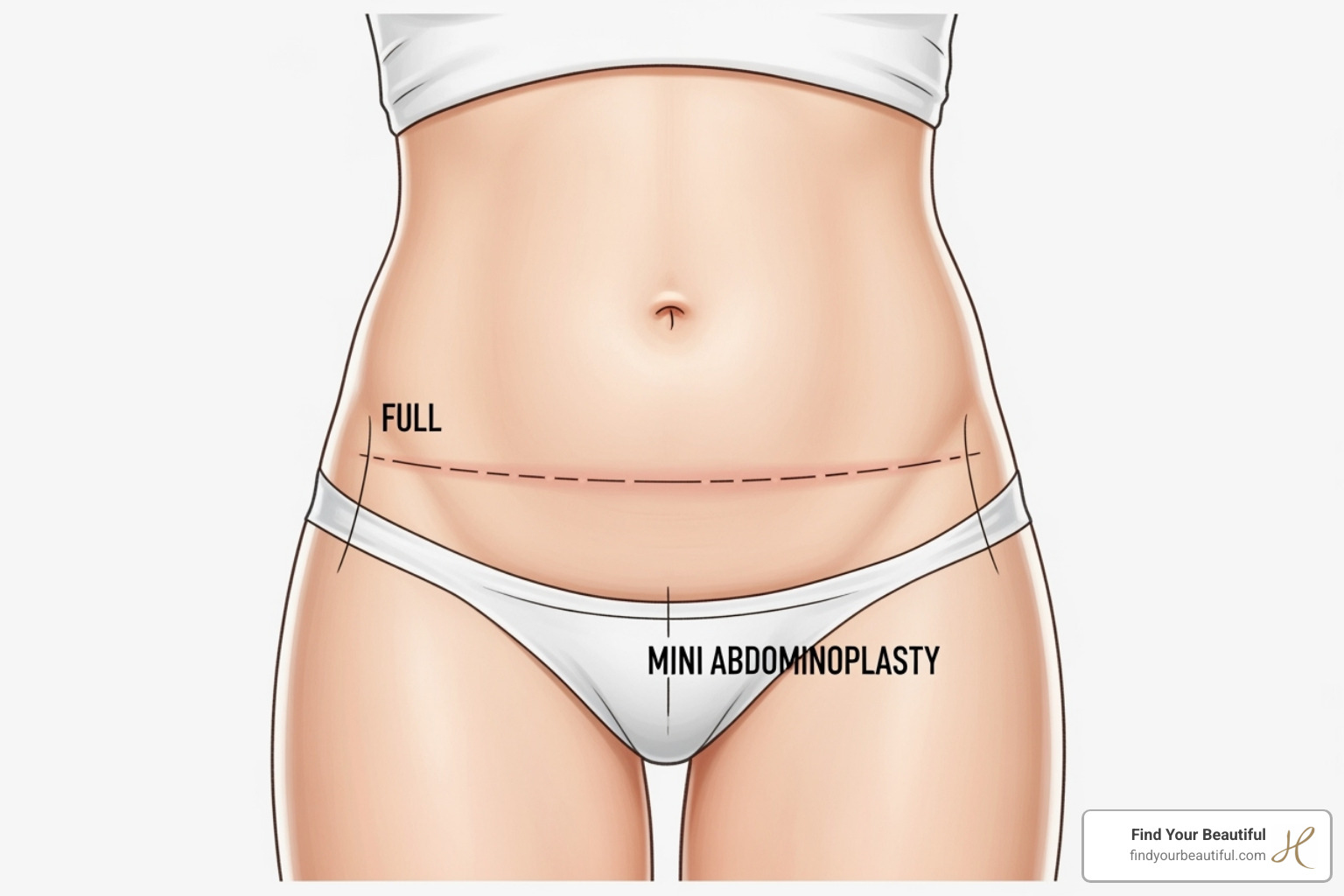
A Full Tummy Tuck is the most common option. It uses a hip-to-hip incision hidden low on the abdomen and another around the belly button. This approach allows for significant skin and fat removal, full muscle tightening, and repositioning of the navel. It’s ideal for those with substantial loose skin and muscle separation.
A Mini Tummy Tuck is for concerns mainly below the belly button. It uses a smaller incision, similar to a C-section scar, to remove the lower “pooch” with limited muscle tightening. The belly button is not moved, resulting in a smaller scar. Learn more about this option here: More info about the mini tummy tuck.
An Extended Tummy Tuck lengthens the incision around the sides to address excess skin and fat on the “love handles” and lower back. This is often chosen by patients after significant weight loss who have concerns extending beyond the front of the abdomen.
A Circumferential Tummy Tuck, or lower body lift, is the most comprehensive choice. The incision encircles the entire torso to address sagging skin on the abdomen, hips, buttocks, and outer thighs, typically after massive weight loss (100+ pounds).
A Fleur-de-lis is a specialized technique for patients with extensive horizontal and vertical excess skin, usually after massive weight loss. It combines a standard horizontal incision with a vertical one, creating an inverted T-shaped scar but allowing for maximum skin removal and dramatic contouring.
During your consultation, our surgeons will recommend the approach that will give you the best possible results based on your unique anatomy and goals.
The Tummy Tuck Procedure and Recovery Journey
Knowing what to expect before, during, and after a tummy tuck helps ensure the smoothest possible experience. We’re here to walk you through every step.
How to Prepare for Your Surgery
Your journey begins with an initial consultation to discuss your goals and medical history. We may use 3-D imaging to help visualize your results. Next is a medical evaluation to ensure you’re healthy enough for surgery. You will need to:
- Stop smoking at least one month before and two weeks after surgery.
- Avoid certain medications like aspirin and ibuprofen that increase bleeding. We will provide a complete list.
- Arrange for help at home, including a ride and support for the first few days.
- Maintain your stable weight leading up to the procedure.
- Set up a comfortable recovery space with necessities within easy reach.
For more detailed preparation tips, check out our helpful guide: More info on preparing for your procedure.
What Happens During the Procedure?
On surgery day, you’ll receive anesthesia, typically general anesthesia, to keep you comfortable and asleep. Your surgeon then makes the incision, usually a horizontal cut low on the abdomen. For a full tummy tuck, a second incision is made around the navel. The most important step is muscle plication, where separated abdominal muscles (diastasis recti) are stitched back together to create a firm, toned core. Next, during skin and fat excision, the upper abdominal skin is pulled down, and the excess is removed. Liposuction may be added to further sculpt the area. If you’re having a full tummy tuck, your belly button is repositioned into a natural-looking new location. Finally, the incisions are closed with sutures, and small surgical drains may be placed to collect fluid. The entire procedure takes one to five hours.
The Realities of Recovery
Understanding the recovery process makes it much easier to steer.

Immediately after surgery, expect to feel tired and sore, managed with pain medication. You will have dressings and drains. Gentle walking is encouraged early on.
The first two weeks are the most intense part of recovery. You’ll experience soreness, tightness, swelling, and bruising. You will wear a compression garment for about six weeks to support healing and reduce swelling. Most patients take at least two weeks off from work.
During weeks 3-6, you’ll see noticeable improvement. Pain and swelling decrease, and you can return to most daily activities around week four. However, you must avoid strenuous exercise and heavy lifting for at least six weeks.
Long-term healing continues for months. While you’ll see immediate changes, final results can take up to three months to appear as swelling subsides. Your scar will continue to fade for up to a year. Maintaining a healthy lifestyle is key to preserving your results. For more detailed information, read our comprehensive guide: More info on the realities of recovery.
Understanding Risks, Results, and Costs
Every surgical procedure has risks, and it’s important to have an honest conversation about them. While a tummy tuck is generally very safe with an experienced, board-certified surgeon, understanding the complete picture helps you make an informed decision.
Potential Risks and Complications
We believe in complete transparency. Complications are rare when patients choose an experienced surgeon and follow all pre- and post-operative instructions. Potential risks include:
- Seroma (fluid accumulation) and hematoma (blood collection), which are typically managed with surgical drains.
- Scarring is inevitable, but surgeons place incisions to be hidden by most underwear or swimwear. Scars fade significantly over a year.
- Infection at the incision site is possible but usually responds well to antibiotics.
- Poor wound healing is a risk, particularly for smokers, which is why quitting is mandatory.
- Numbness or changes in skin sensation around the treatment area can occur and may be temporary or permanent.
- More serious but rare complications include blood clots and anesthesia risks.
For those interested in diving deeper, you can review evidence-based information: Evidence-Based Medicine: Abdominoplasty Risks.
What to Expect from Your Tummy Tuck Results
The results of a tummy tuck can be truly transformative, giving you renewed confidence.
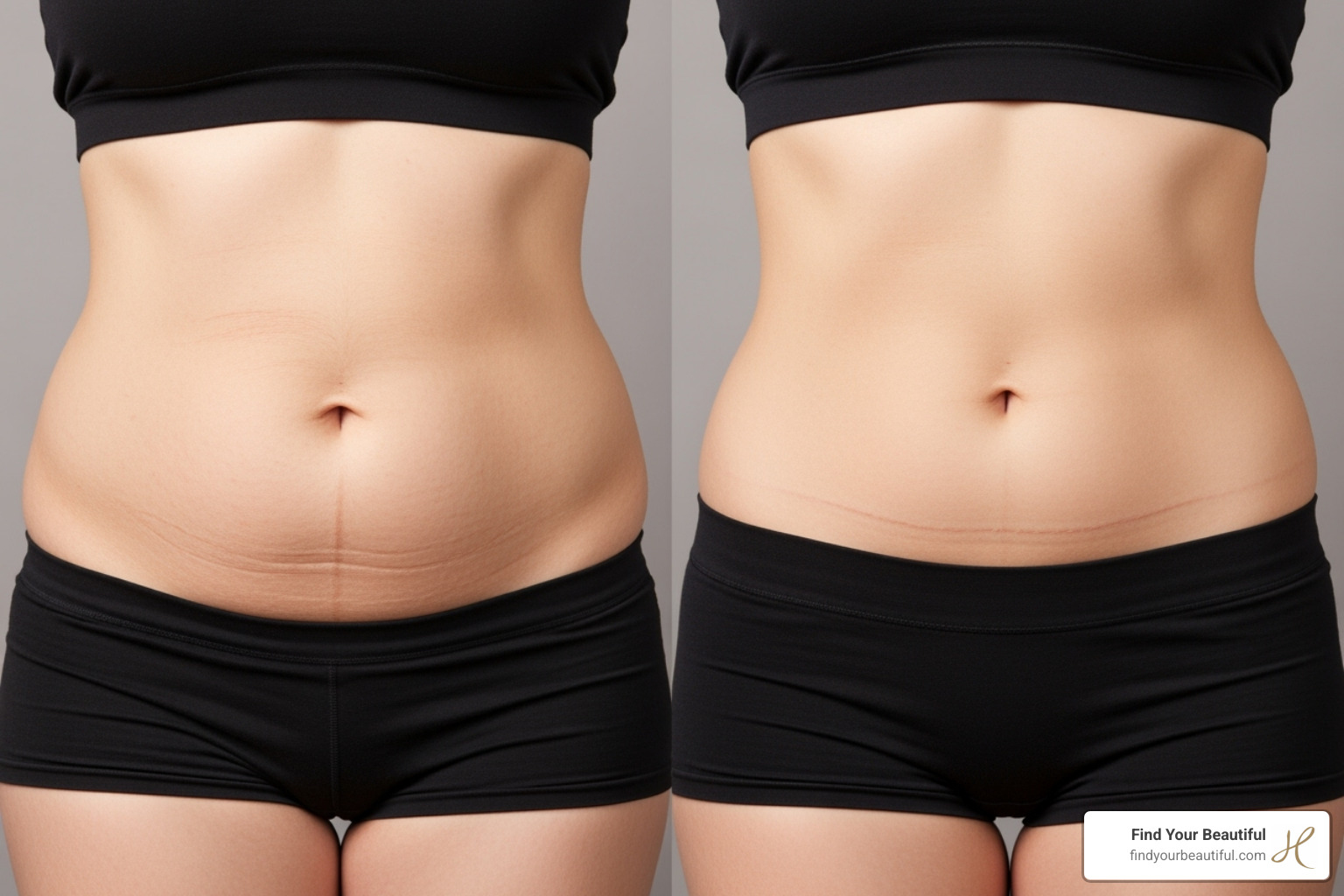
You can expect a flatter, firmer abdomen as excess skin is removed and muscles are tightened. Your overall body contour will improve, creating a more balanced silhouette that is often improved with liposuction. Any stretch marks on the removed skin (usually below the navel) will be eliminated. You will have a permanent scar, but it is placed to be easily hidden and will fade significantly over a year. The longevity of results is a major benefit; the effects are permanent, provided you maintain a stable weight and have no future pregnancies. Patience is key, as final results can take up to three months to be fully visible as swelling subsides.
We’re incredibly proud of the changes our patients achieve. Take a look at the amazing results from our expert surgeons: View our tummy tuck gallery.
Tummy Tuck Cost and Insurance Coverage
Cost is an important consideration. The total investment for a tummy tuck is unique to each patient and is influenced by the surgeon’s fee, anesthesia fee, facility costs, and the complexity of your procedure.
A tummy tuck is typically considered cosmetic and is not covered by insurance. An exception is a panniculectomy, the removal of an overhanging fold of skin (pannus) that causes medical issues like rashes or infections. This may be deemed medically necessary and covered by insurance.
We offer various financing options to help make your procedure more affordable. Our team will discuss payment plans during your consultation to help you invest in yourself without financial stress.
Tummy Tuck vs. Other Procedures: A Comparison
Many patients wonder whether they need a tummy tuck, liposuction, or a panniculectomy. While all three procedures improve the abdomen, they solve very different problems.
A tummy tuck is the most comprehensive option. Its goal is to create a flatter, firmer abdomen by treating excess skin, stubborn fat, and separated muscles all in one surgery. The ideal candidate has loose skin and muscle laxity. The procedure involves a hip-to-hip incision, muscle repair, and a 4-6 week recovery. It is generally not covered by insurance.
Liposuction has a simpler goal: removing localized fat deposits. It only treats excess fat and is best for candidates with good skin elasticity. It uses tiny incisions, involves no muscle repair, and has a much quicker recovery. Like a tummy tuck, it is not covered by insurance.
A panniculectomy’s goal is to remove an overhanging “apron” of skin (pannus) that causes medical issues like chronic rashes or infections. It treats the hanging skin and fat but does not address muscle separation. The key difference is that a panniculectomy may be covered by insurance if deemed medically necessary.
The bottom line is that a tummy tuck is best for loose skin and separated muscles, while liposuction is for stubborn fat with good skin tone. Often, we combine a tummy tuck with liposuction for the most sculpted results. During your consultation, we’ll help you determine the best approach for your goals.
Choosing Your Surgeon and Taking the Next Step
Choosing the right surgeon is the most important decision in your tummy tuck journey. The first thing to look for is board certification in plastic surgery, which signifies years of specialized training and a commitment to the highest standards of patient care. Our surgeons at Find Your Beautiful exceed these requirements with extensive experience and expertise in body contouring.
When researching surgeons, ask about their experience and review their before-and-after photos to see if their aesthetic vision aligns with your goals.
Your consultation is your chance to get all your questions answered about the best procedure for you, potential risks, and what to expect during recovery. A good surgeon will welcome your questions and address all your concerns.
Patient safety is our top priority. Our facility on Stone Oak Parkway in San Antonio, TX, combines luxury with the highest safety standards. We are committed to supporting you through every part of this transformative experience.
Want to learn more about our surgeons and their qualifications? More info about our expert surgeons.
Ready to take the next step toward the flatter, firmer abdomen you’ve been dreaming of? Our compassionate team in San Antonio is here to guide you.